Entry point
Start with the entry point 
Join the free mini-course
Here you can join the free “Entry Point” mini-course and enter the Workshop.

An online platform devoted to philosophical education, research, and the development of phenomenological practice in a contemporary context.
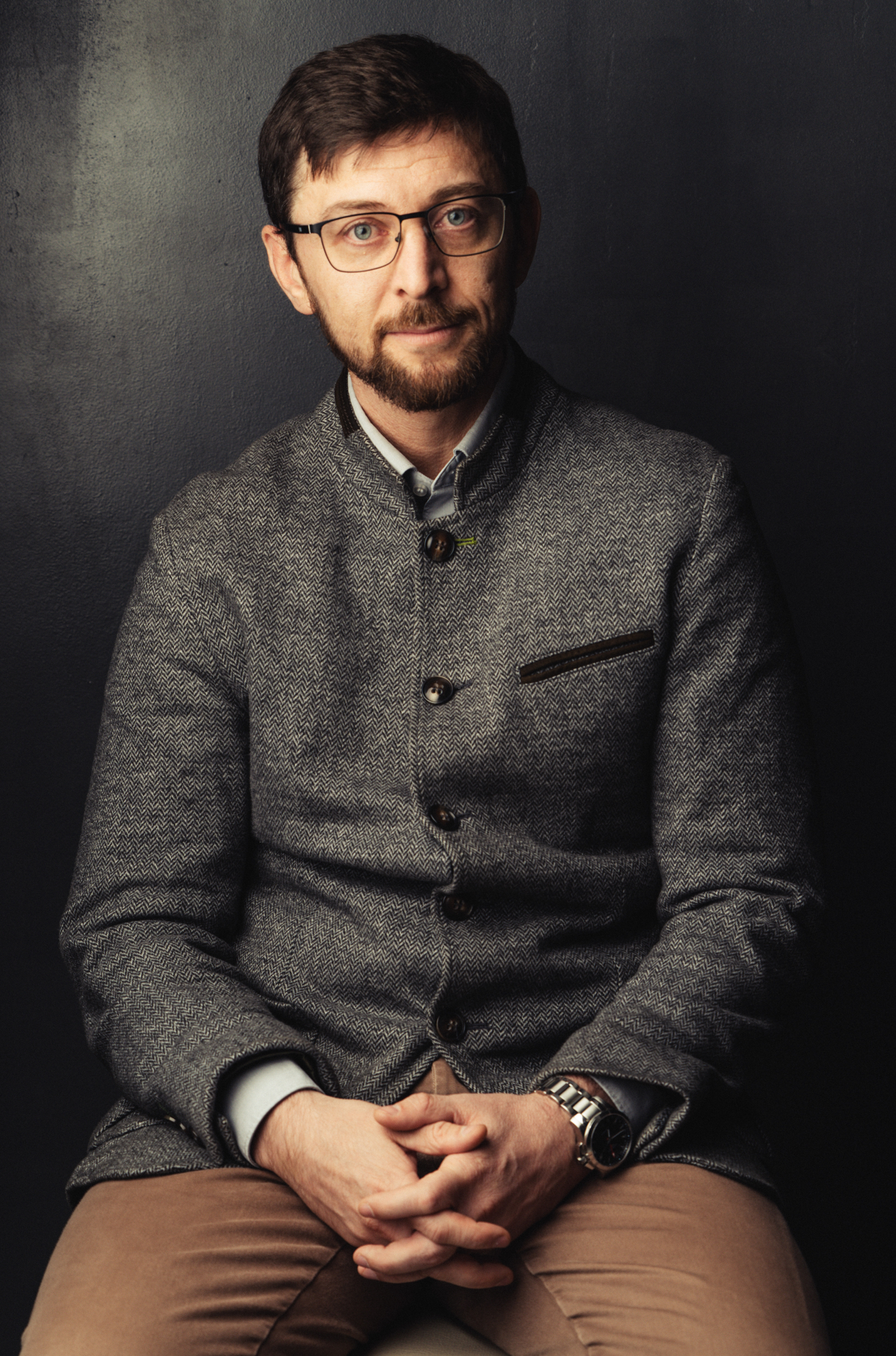
Serhii Forkosh holds a doctorate in philosophy and is a philosopher, translator, and lecturer — the founder of the Phenomenology Workshop.
His intellectual work centers on phenomenology as a method for describing and analyzing human experience, and on those forms of thinking in which philosophy returns to the living bond between the human being and the world.
At the heart of his research is the question of how experience acquires a structure of meaning: how things disclose themselves in perception, how the presence of the other is formed, how embodiment, time, language, and memory take part in the becoming of the human world. This approach joins the rigor of the phenomenological method with attention to concrete forms of life.
Serhii Forkosh’s philosophical work is bound up with the European phenomenological tradition — above all with Husserl, Heidegger, Merleau-Ponty, and Richir — as well as with contemporary studies of embodiment, intersubjectivity, affectivity, and the life-world.
The Workshop is arranged as a series of spaces — places of philosophical practice in which a subscriber meets phenomenology in different ways: through reading and research, viewing, writing, conversation, and image. Some spaces are open to everyone, others to regular subscribers.
A Workshop subscription costs €4.99 per month. It includes:
Not sure where to start? There is the “Entry Point” — a free mini-course open to everyone. About 15 minutes and a few simple steps: read, look closely, write. No preparation and no commitment — a first acquaintance with the Workshop’s work, after which it becomes clearer what phenomenological practice is and which path to choose next.
You can shape your own studies — choose separate lectures from our courses and gradually build your own path through the topics that interest you.
You can take a single lecture, a few topics, or gradually assemble your own mini-course — at your own interest and your own pace.
(Tap a lecture — it goes into your set below)
 1 Being and nothingness: a state of openness 24.99 EUR
  2 The one and the many: a state of structure 24.99 EUR
  3 Appearance and thing: a state of depth 24.99 EUR
  4 The living and the non-living: a state of rhythm 24.99 EUR
  6 Culture and world: a state of the symbolic 24.99 EUR
  7 History and technology: a state of mediality 24.99 EUR
  1 The definition and history of phenomenology 14.99 EUR
  2 Categories of phenomenology 14.99 EUR
  3 Methods of phenomenology 14.99 EUR
  4 The life-world 14.99 EUR
  5 The phenomenology of the body 14.99 EUR
  6 The phenomenology of imagination 14.99 EUR
  7 The phenomenology of self-consciousness 14.99 EUR
  8 Intellectual intuition 14.99 EUR
  1 What does «phenomenon» mean? 24.99 EUR
  2 Appearance as rhythm: the schematism of becoming 24.99 EUR
  3 Aesthetic reflection and the state of exposure 24.99 EUR
  4 Space and time as appearing 24.99 EUR
  5 Speech before language: the phenomenon as symbol 24.99 EUR
  6 Essence as a break in stability 24.99 EUR
  7 The world as a phenomenal circle 24.99 EUR
  8 The cosmos as phenomenal unfolding 24.99 EUR
 Nothing selected yet
This book grew out of one persistent feeling: phenomenology too rarely becomes what, by its very design, it is — a practice of seeing, a discipline of attention, a way of being present at experience.
In “The Notebooks of Malte Laurids Brigge,” a young man arrives in Paris and says: “I am learning to see.” What follows are separate acts of looking closely — into a face, a room, a hospital, into fear.
This book is arranged the same way: each of its texts stands on its own. A boy walks to school on a frosty morning with a briefcase covered in model airplanes. A man meets the devil at night and talks with him wearily, as with a late guest. A city with burnt-out windows looks onto playgrounds. The Vienna Woods, a bar counter, an airport, a mirror at one’s back.
Here the prose itself begins to take on rhythm, and I leave it that way. Several of the stories turned out closer to verse than to prose, and the poetry section is half made up of prose poems. The border on which this book is written runs inside literature, between prose and verse.
“I experience this course not as a set of lectures but as a carefully built journey through the fundamental states of human experience. The Workshop teaches not a set of concepts but a particular way of being in the world — attentive, rhythmic, able to hold together appearance and nothingness.”
“The main and most valuable thing in the course, for me, was meeting a rare kind of teacher. If one can imagine an ideal teacher, for me that is precisely Serhii Forkosh.”

“I have taken Serhii Forkosh’s third course and consider it a great and rare piece of luck. It feels as if these courses were created just for me.”
“For me this course was about contact with myself, about discovering myself otherwise, and about the present yet non-obvious — a new way of looking at things and phenomena, a shift in the place from which, and the way in which, you look.”
“Each lecture — a meditation, an immersion, a presence at the movement of thought — helped me grasp something beyond my own capacities. That is a distinct art of Serhii Forkosh’s.”
Everything people usually ask before joining. If your question isn’t here, write to us: phenomenology@forkosh.at or via a Direct Message on the Workshop platform.
Join the WorkshopWith the “Entry Point” — a free mini-course open to everyone. It takes about 15 minutes and lets you try the Workshop’s work in practice. Afterward it becomes clearer what phenomenological practice is — and which path in the Workshop to choose.
No. All concepts are introduced from scratch; you don’t need to read Husserl in advance. What matters is not erudition but a readiness to look, read, and write attentively — and that is exactly what we learn.
You choose the rhythm yourself. One or two short practices a week and taking part in meetings when you can is enough. The materials don’t disappear: you can return to the lectures, texts, and recordings at any time.
All meetings take place online via Zoom, so you can join from anywhere. Over time, in-person meetings in Vienna will be added — we are already preparing this format.
Access to all the Workshop’s spaces: the Library and Video Library, the weekly letter, the Monday meetings of the Phenomenological Club, the lectures of the “Phenomenological Meditations” series (free for subscribers), and the space for participants’ texts. Plus discounts for regular subscribers on courses, books, and other Workshop events.
Yes. Events, the Gallery, Reviews, and the mini-course are open to everyone. For individual lectures you can buy single tickets.
Yes. Live courses and seminars are held at the Workshop regularly; a course usually lasts about two months. Recordings of past courses are available for purchase in the “Workshop Offerings” section. Regular subscribers get a discount on course recordings.
Yes, and many participants come for exactly this. Phenomenology is a method that can be applied in any field: wherever there is experience, perception, and another person. And the courses on the phenomenology of psychotherapy and the phenomenology of education are built around specific professions — for those who want to bring the practice directly into their work.
Not a set of notes but a skill: the habit of noticing and distinguishing, your own phenomenological journal, the texts you’ve read — and a community you can keep returning to.